General Information about Tashkent
Country name, international abbreviation: Uzbekistan, UZ, UZB
Settled: 5th to 3rd centuries BC
Type: City Administration
Area (calc. in 2021): 435 km2 (168 sq mi) and still growing
Population: 3,212,200
Time zone: UTC +5
Area code: 71
Average temperature/year: 21.6C
This glorious ancient city, which appeared on one of the crossroads of the Great Silk Road more than 2 thousand years ago. During its history, it changed many names - for example, the names Chach (Chach-tepa) and Shash (Shash-tepa), which came from the Sogdian language, meant “Hill of Shash”, Binkent, translated from Turkic, means “main city of the region”; as well as the name Madina-ash-Shash, which sounded in Turkic as Shashkent (Tashkent) - “stone city”.
After the earthquake of 1966, which almost completely destroyed the central part of the city, Tashkent was restored in just 3.5 years, and the city underwent extensive reconstruction in the years following the earthquake. All the fraternal republics helped to reconstruct the capital; with their assistance, several new neighborhoods were built. In memory of what happened in Tashkent, the “Courage” memorial complex was installed.
Nowadays Tashkent is undergoing rapid urban development – new living complexes appear as fast as mushrooms after the rain. Tashkent City Park opened to the public in October 2019. But Shashtepa and Ming O'rik, ancient objects of Uzbek heritage, are in danger of breakdown. Fortunately, the government already knows about this situation and has announced the start of the restoration process.

Tashkent’s cuisine is taken from different regions. Many traditional dishes are rich and hearty.
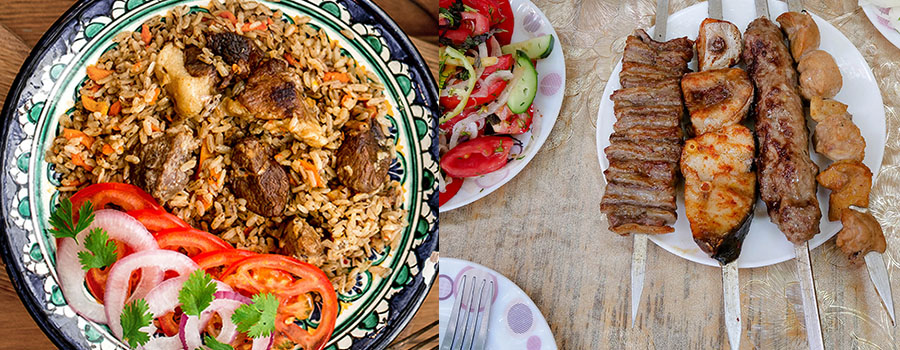
Guests of ‘Anur Tour’ usually prefer to try out plov with beef and olive oil, finish it with a salad called ‘achiq-chuchuq’ (tomatoes & cucumbers with onion and literally nothing else), and after all that – norin (cut pasta with horse meat in a bouillon) and samsa (who doesn’t know about samsa?)
So here, we list all the must-try dishes from Tashkent cuisine:
- Plov (wedding plov and choyxona plov) (also known as pilaf or osh) is a savory, aromatic rice dish cooked with meat, onions, carrots, and warm spices.
- Shashlik is a popular dish of marinated, skewered, and grilled cubes of meat
- Salads such as achiq-chuchuq & choban
- Norin (or naryn) is a traditional Uzbek noodle dish made with finely shredded, handmade dough and boiled meat - most commonly horse meat or beef.
- Lagman (also spelled laghman) is a central hearty noodle dish originating from Uyghur and Dungan cultures, widely popular across Uzbekistan, Kazakhstan, Kyrgyzstan, and China (Xinjiang). It features thick, hand-pulled wheat noodles served in a rich meat and vegetable sauce.
- Shurva or mashxurda
- Black tea with lemon (so-called ‘lemonchoy’)
A classic Uzbek breakfast contains fresh-baked bread (so-called ‘non’), a small cup of kaymak (liquid sour cream), dried fruits such as peach, grape, and apricot, and on top of that – samsa or homemade cheese. In summer, Uzbek people prefer to eat fruits & vegetables more than in the winter period.
Most of Uzbek cuisine is heavy and requires a short rest after lunch.
Tashkent has a metro network, and it continues to expand. The city is known for having probably one of the most beautiful metro stations in the world. Many underground stations feature mosaics, decorative columns, and colourful Uzbek motifs. Themes also include literature, history, and space exploration. Tashkent was the first city in Central Asia to build a metro during the USSR times. Nowadays it also has modern buses & taxi transport, but no more trams and trolleybuses.
Tashkent has a network of buses and minibuses; the average waiting time is 5-8 minutes, depending on the time of day.
In addition, as we mentioned above, Tashkent’s metro is stunning and breathtaking. The metro was designed with earthquake-resistant structures suited to the region’s seismic conditions.

Our company also rents out fine cars not older than 3 years. We offer local brand cars such as the Chevrolet Cobalt, Chevrolet Lacetti, and Chevrolet Malibu-3, and for group driving, we offer Mercedes mini-buses and big buses under the brand Oriental.
Feel free to ask us about car rental when booking your tour! Your driver's license is required, along with knowledge of local driving rules.
Speaking of other companies, we notice that many of them rent out Ravon 2 or 3, and mainly in white. The price is by request and often calculated depending on your wishes. Many of these rental cars are parked at the international airport of Tashkent named after Islom Karimov.
The currency is the Uzbek som, and on 09.28.2026, 1 U.S. dollar costs 11846,95 soms.
Local stores, cafes, and restaurants accept cash in soms, but many of them also accept foreign cards in Visa or MasterCard. Due to the financial revolution of Uzbekistan, you can withdraw cash from a card at almost any big bank branch with a small fee.

Not far from the current railway station ‘North ’, you can see a unique historical monument - the ancient site of the ancient settlement Mingurik. It was here that the ancient settlement of Chach was once located, from which the present Tashkent subsequently grew.
In the old part of the city, not far from the Chorsu Bazaar, there is the largest madrasa of the city - Kukeldash Madrasa, built around 1570 and being part of the architectural ensemble of the once main city's historic central square.
Not far from the Kukeldash Madrasa, there is one of the most ancient mosques in Tashkent - the Jami Mosque, also known as the Juma Mosque, which is more than 12 centuries old. Now the mosque is named after Khoja Ahrar Vali.
There, in the Old City, in the depths of one of the residential areas, there is the architectural complex Hazrati Imam (Khast-Imam), built near the grave of one of the first Tashkent imams - the scholar and poet Hazrati Imam, whose full name is Abu-Bakr Muhammad Kaffal Shashi. The Hazrati Imam Complex was built and expanded over a span of five centuries, from the 16th century to the 21st century, and consists of the Barak Khan Madrasah, formerly housing the Muslim Board of Uzbekistan, Muyi Muborak Madras, Tilla-Sheikh Mosque, Hazrati Imam Mausoleum, Namazgoh Mosque, and the Imam Bukhari Islamic Institute.
Not far from Alisher Navoi Avenue, near the Urda Square, is the architectural complex of Sheikhantaur, consisting of several mosques, mausoleums, a cemetery, and a madrasa. The complex got its name in honor of Sheikh Hovendi at-Tahur, whose tomb-mausoleum is the first building of the complex and dates from the XIV century.
In the suburbs of Tashkent, there is another historical monument - the Zangi-ota ensemble, built, according to legend, by order of Amir Temur himself at the end of the 14th century.

In the new part of the city - the one that was founded after the conquest of Tashkent in 1865 by the troops of the Russian Empire and separated from the Old City by the Ankhor Channel - has its own attractions. Of course, they are much younger than those located in the Old Town, but this is no less interesting. One of the business cards of the capital is the Tashkent television tower with a height of 375 meters and an observation platform open to the public.
A true work of art is the Tashkent Metro, recognized as one of the most beautiful in the world. Its stations are skillfully decorated not only with marble and granite but also with glass, plaster, and mosaic, and also decorated with frescoes, panels and bas-reliefs with oriental ornaments.
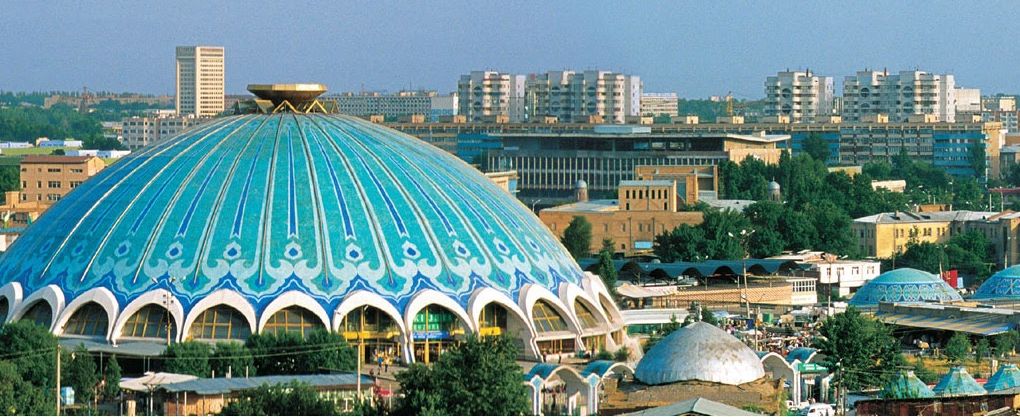
Another place to visit is Chorsu Market - one of Tashkent’s oldest bazaars., located under a beautiful dome as if floating in the air. It is Chorsu, which is located in the Old Town on the former Eski-Zhuva Square, which is considered to be a heart of old Tashkent. Here, there is a brisk trade in everything that should be in the oriental bazaar — fruits, sweets, nuts, spices, souvenirs, ceramics, and many other handicraft items.